Tuesday, 30 April 2013

Getting back to normal living and the arrival of Felix.

We all soon settled down to a normal routine, but in a very different environment from that we had in Somerset; David and Dad went off to work each day, it was school for me and Mum returned to being a housewife. Two months passed by and Dad returned home early from work with a small bundle.   He had met a hunter at the garage, newly returned from an expedition. Apparently, while out in the bush, they had found a female leopard caught in a trap and her state was such that they had to put her out of her misery.  They then realised that she was heavy with milk and that she must have cubs somewhere.  The trackers were put to work and they soon discovered two tiny cubs with their eyes still closed and mewing with hunger.  To this day, I never found out how Dad really got involved, but the end result was that we were living in a caravan and bringing up a leopard cub!  The hunter had said he could only cope with one and was at his wits' end what to do with the other; a daft thing to say with my father around, as he loved any type of animal!  He always said that if it had not been for the war and becoming an engineer in the Merchant Navy, plus of course his parents owning a petrol and service station, he would liked to have been a veterinary surgeon.
Felix growing up and showing that he did have big teeth!

After the arrival of Felix, as he was named, no one got very much sleep, as it seemed to be everlasting feeding time; but as he got bigger, it was just like having a large cat around.   We had been doing some house hunting so that I could move to a private school, but now if Felix was to become part of the household, it was imperative that we found somewhere larger than a caravan to live in.  In those days, there were no laws concerning the keeping of wild animals and we never had any problems where the authorities were concerned.
Our new home

We finally found a very nice house set on a very large plot, in the suburb of Greendale, just outside Salisbury. We moved lock, stock and barrel with the caravan and although we stayed in the van for a short time while we were decorating and buying furniture, our lifestyle improved dramatically!  After completing one term at my first Rhodesian school, I moved to the local junior school, named after Courtney Selous, a famous Rhodesian explorer.  This was still a government school, but it was very up-market compared to where I had been!   Felix had a large ‘kennel’ built, where we could fit him with a harness and tether, so he was able to have some freedom outside. At the times we were at home, he was in fact just loose walking around the house.  
Myself at Courtney Selous school fancy dress - selling my oranges dressed as Nell Gwynne!

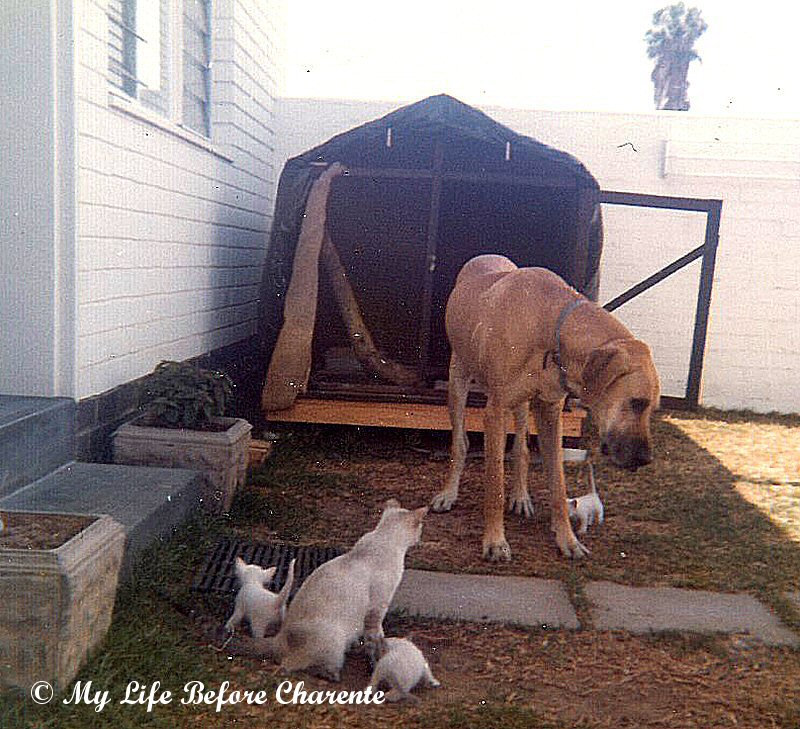
Felix when still quite small!

With my Dad, and  a little older

It was quite amusing when we had visitors, especially if they did not know there was a leopard at large.  We always made sure that the door was closed and when people arrived, invariably Felix would be out in the kitchen; this was where he used to spend a lot of time with Mum.   After he noticed that she had gone missing for a period of time, he would then go in search of her, invariably slinking quietly into the lounge, where he would jump up onto the nearest chair!  Unfortunately we never did get a picture of the frozen expressions we saw many times on the faces of unsuspecting people!   Felix loved my mother and she had a hard time cleaning the house, as a duster or a broom was only there to be played with!  Amazingly enough, there was very little damage done inside the house or to the furniture; I suspect that all the claw sharpening was done on a large log that lay by the side of his kennel.  
Stretching his legs!


Getting a cuddle from our house servant, Tiki, who loved spending time with Felix.
We all suffered from his claws from time to time when the play got a bit rough, but never at any stage did any of us ever feel unsafe or in any danger from him.   Tragically, at the age of two and a half we had to have him put to sleep, having suffered a broken back.  We had been out and Felix had been at the kennel with the harness on.  There had been no reason to lock him up, as our African servant who loved Felix as his own, was on the property.   On our return, we found our servant sitting crying, next to the prone body of Felix. He told us that children from down the road had come on to our property and, finding a nearby pile of bricks, proceeded to throw them at Felix.   One brick obviously was thrown particularly hard, catching a vital spot and our Veterinary Surgeon who promptly called round, said that although he would have x-rays taken, he was certain that Felix would never walk again.    We were all broken hearted that such a lively animal should come to such a sad end.  It was many months before we could sit in the lounge without expecting a large cat to arrive on our laps.  Many tears were shed then, and for a long time afterwards.   As he had grown bigger, we had been prepared  for the time when we would have to make arrangements for Felix to be sent to a Wild Life Park or similar, but none of us had foreseen an outcome as sad as this.


My Life Before Charente to be continued :-) 

 
The section of my life story during our overland trip is published on Kindle if you should be interested:-
 THE GREAT 1953 TREK
See


Monday, 22 April 2013

The English press record our adventurous trip!


I  thought that, before I start the story of my life in Rhodesia,  I would include this newspaper cutting which was printed in the Evening Chronicle, the daily paper circulated in the Bath area in Somerset, shortly after our arrival in Salisbury.

As it is difficult to read, this is a reprint.

BATH MAN TELLS OF 8,000 MILES BY CAR TO AFRICA.

Elephant Gave Them Their Most Anxious Moment.

After a road journey of nearly 8,000 miles from Bath, Mr and Mrs Donald Beak, formerly of Fiveways Garage, Batheaston, and their two children are now settling down in Southern Rhodesia.

They went there the hard way, driving in their own Land Rover through France, across the Sahara and on through Africa, to start a new life in Salisbury, Southern Rhodesia's capital.

Now they are making their home in a caravan which they had sent on to Southern Rhodesia by sea.  In their hotel just after their arrival Mr Beak said " We decided to emigrate because of the high taxation in England.  We chose Southern Rhodesia because we thought it would be the most pleasant of the places in the Commonwealth, to which we could go.

WIFE'S IDEA
"Going by road was my wife's idea.  We spent six months planning the trip and another six months getting ready.  We started off from Bath on Jan 22 - my wife Dulcie, our son David, aged 16 and our daughter Diane aged nine, and myself."

After crossing France they sailed on Jan 29 to Algiers.  "On Feb 3, we started what we expected would be the worst patch of the journey, the crossing of the Sahara.  It is waste land of every description - mountains and flats, sand and rock, with no sign of life of any kind.

"Actually it was not as bad as we had expected.  The road is a rough track, but it was negotiable for a vehicle like ours.

"We stopped every so often for water, which was available at wells; there was also petrol at pick up points.

"There is a certain amount of traffic across the desert.  Transport trucks supplying the desert villages make a series of patrols and the Foreign Legion forts keep in touch by radio, so travellers are not completely lost."

THE TRUE DESERT
"The true desert is the section between Tamanrasset and In Guezzam - 250 miles of soft sand.  We got across it in 10 hours and had to dig ourselves out only twice.  I got across by simply driving flat out.  For long stretches there was no road at all and we had to drive by compass.

"We stayed four days at the hotel in Kano.  Here £70 was stolen from my brief case in a hotel wardrobe.

"On the way to Fort Archambault we went through Bongor, the most primitive town we saw on our journey,  The natives wore literally no clothes and were still using the disc ornaments which they carry in the lips and ears.  Some were carrying bows and arrows. They were though very friendly and brought us a bowl of milk.  The roads here were fair, but there were many hazards. We crossed the rivers on primitive native ferries and once we had to make a big detour because a bridge had collapsed.

"Once a bridge collapsed under us and we could not get the car free until 60 or 70 natives had come to our rescue.

"We crossed the equator at 6,000 feet and had never felt so cold in our lives.  We did not have a 'crossing the line ceremony' because we were not quite sure where the line was."

After crossing the equator, the party had an experience which they will remember for the rest of their days.
"Driving along a narrow road we suddenly saw the hind quarters of an elephant - 15 feet away"  Mr Beak said.  "He turned around, blocked the road, flapped his ears and raised his trunk; it was an anxious moment. "He started to walk towards us.  We just banged into reverse gear and drove back 150 yards - and believe me, no car ever reversed so fast!

WADDLED OFF
"For 15 minutes the elephant stood and watched us.  We thought of all the stories we had heard about elephants in that part of the country over-turning cars.  Then the elephant rubbed his back on a tree, turned and waddled off.  We decided to make a dash for it.  We drove towards the spot where he had left the road - only to find him touching distance away.  We just scraped past him racing by so as to give him no time to do anything.  It worked - we didn't see any more of him."

Later they heard lions, and saw a leopard crossing the road at night.

OVER THE BORDER
When they crossed the border into Northern Rhodesia they felt they "were getting somewhere".  By now the miles to Salisbury had come down to 3 figures - all the way so far it had been four.

"We crossed the Zambezi into Southern Rhodesia at Chirundu and drove to Salisbury.  When we started the mileage on our speedometer was 5,160; when we arrived  we had clocked up to 12,896 - we had done 7,736 miles" Mr Beak said.

" We didn't have a puncture throughout the journey. We broke three springs, which we replaced, and we replaced a water pump gland; that was all the mechanical trouble we had.  To drive to Southern Rhodesia is a good trip for an engineer, but it's no ride for a novice.

"And Southern Rhodesia, well here we are now, living in our caravan at Coronation park, Salisbury;.  It looks fine - we like it very much.  I am going to get a job and look around" he added.


My Life Before Charente to be continued :-) 

 
The section of my life story during our overland trip is published on Kindle if you should be interested:-
 THE GREAT 1953 TREK
See


Tuesday, 16 April 2013

Setting up a new home in Southern Rhodesia.


March 15 (Sunday) Total Land Mileage from England 7736 

After a very lazy start to the morning, we went out to check the Land Rover and go for a walk. We found ourselves walking over a bridge by the railway station; great excitement, there was our caravan on a goods wagon, right below us! We had been told that it would take at least two months to arrive, so this was completely unexpected. We later discovered that each and every person who had handled the caravan during its trip was worried about damage and it was hurried through every port with no delays. Our life was really now about to begin in our new country, as our home had arrived!

Later in the day, my father went outside to check on the Land Rover again and there he found a gentleman walking round and round the vehicle and showing a great deal of interest. He saw my Dad and said “Hey have a look at this, I am sure that this vehicle must have driven overland from England looking at the condition of it and the tell-tale number plates”! For a lark, Dad just replied  “Do you really think so?” and a long conversation carried on from there, with Dad never letting on he was the driver!  He came back into the hotel laughing and related the entire story to us. 

Also later that day, the press arrived at the hotel, and many photos and stories later, we appeared as headline news in the Rhodesian Herald newspaper. We often wondered if the guy who had been talking to my Dad earlier saw the paper the following day and put two and two together!  As a result of the article, my Dad received a call from a local garage and was offered a job, starting as soon as he was able!
Sorry I had a problem scanning this article, because it is glued into the photo  album! I did think, though, that it was worth reproducing it here.
The centre words read : Mr Donald Beak and family accomplished this amazing journey over the trackless Sahara without a puncture.  Their car was fitted with Michelin tyres supplied by.....

LIFE IN RHODESIA

Our first priority was to clear the caravan through Customs and find somewhere to park it. We found a camping park on the outskirts of Salisbury and, with no problems, rented a site and by the end of the week we were ‘at home’ in the caravan with all mod cons laid on!  David at 16 had left school in England with ideas of finding a job on arrival in Rhodesia. Both Mum and Dad were surprised when he said that he wanted to become a mechanic, as prior to the trip and in helping Dad on our journey, he had shown no interest in anything mechanical. As it happened, he managed to sign up as an apprentice very soon after our arrival and as each year passed, he was never anywhere other than top of the class!  At nine of course, I had to go back to school and although both Mum and Dad did everything possible to try to get me into a private school, I ended up at the local government school for the remainder of 1953. We only discovered later that the camp-site had a very bad name and this mention of our address put a halt  to any possibility of a private school accepting me! 
Our 'new' home
The other very important factor at this stage, was to find a doctor for me to have a complete check up and make sure that I could continue with all sports at school and live a normal life once more. This was duly done and I was given a completely clean bill of health!

It is interesting to note that the year of our arrival was the centenary year of the birth of Cecil John Rhodes.  Some of the one shilling stamps were reproduced on postcards as collector's items, two of which are shown below.

On the back of the cards I found the following information:
(Southern Rhodesia 1/- 1953) GREAT ZIMBABWE. The ruins of Great Zimbabwe are the most extensive, yet most mysterious in sub-Saharan Africa.  The settlement is believed to have been started about 800 A.D. and then deserted about 1600 A.D. owing to the lack of firewood and grazing in the surrounding area. It may have been a compound for holding slaves prior to their shipment across the Indian Ocean at Sofala. (Beira, Mozambique)


(Northern Rhodesia 1/- 1953) NORTHERN RHODESIA/VICTORIA FALLS. Issued to commemerate the centenary of the birth of Cecil John Rhodes, 1853 - 1953, this stamp depicits an aerial view of the Victoria Falls and the bridge taken from the N. Rhodesian side.  It was Rhodes who instructed that the bridge be built within spray-distance of the falls, although he never saw it himself.


My Life Before Charente to be continued :-) 

 
The section of my life story during our overland trip is published on Kindle if you should be interested:-
 THE GREAT 1953 TREK
See
 http://www.amazon.co.uk/THE-GREAT-1953-TREK-ebook/dp/B008KK0KHU/ref=pd_ys_iyr1

Monday, 8 April 2013

Arrival in Southern Rhodesia - at last!

March 13 1953 (Friday) Land Mileage 7140 


What a pleasure to wake up inside a hotel and not have the inconvenience of rain and a wet Land Rover!   Breakfast cooked for us was total luxury after the last few days. We filled the tanks up with fuel once more and we were on the road again soon after 08h00. The road was a great improvement on the surfaces of recent days and we quite enjoyed the 82 mile trip  to Kapiri M'Poshi.

This was just a small railway station with a hotel, petrol and stores. We were there by mid-morning, but decided that we should top up again with fuel while we were able. Carrying on from there through Broken Hill, we had a lunch time break and drove onto Lusaka, the capital of Northern Rhodesia. We found a Land Rover agent there and Dad bought a new speedo cable, as ours was behaving in a very strange manner!   We had been told that we needed to report to Customs here, so maybe that was why the Ndola Customs officials were not interested in finding out who we were!   We had no problems and after leaving Lusaka, we saw our first snake on the road. We had no idea what kind it was, but so long as we were a safe distance from it, we did not really care too much. Although we were all used to snakes, when the species was unknown and the possibility of it being poisonous was quite a strong possibility, precaution was the order of the day! 

We carried on to the small village of Kafue, where we filled up with fuel yet again and then up to the bank of the Kafue River, where we expected to find another ferry. Here we had a wonderful surprise - they had just completed a bridge across the river!   We carried on for some distance stopping at 17h30 in a quarry for the night. We lit a fire and had an enjoyable evening sitting by the fire having a chat, knowing that if all went well, we should arrive at our destination the very next day. 

March 14 1953 (Saturday) Land Mileage 7414 

We were up at 06h00, feeling quite excited now that journey's end was in sight. We had a good tidy up and breakfast before we hit the road at 07h00. We arrived at the Northern/Southern Rhodesia border an hour later.
First view of the Otto Beit Bridge, built in 1938 by the Cleveland Bridge and Engineering Company, crossing the mighty Zambezi river, which forms the border between Northern Rhodesia and Southern Rhodesia (Now Zambia and Zimbabwe). It was the first modern suspension bridge outside the USA built with parallel wire cables.
We passed very quickly through Customs and then Dad drove across the bridge, sited near Chirundu Gorge. Mum, David and I walked across the bridge with shouts of joy; we had at last arrived in Southern Rhodesia!!

Mum, myself and David walking over the bridge. Note, I have my pith helmet on !
We went into the Customs and Immigration on the other side of the bridge and found we had more forms to fill in here, than at any other point of the journey! 

We still had a day's drive ahead of us, so we were soon on our way again, passing through large valleys and thick vegetation. We kept our eyes on the road ahead, hoping that we were not going to come across another angry elephant!

We were then stopped by a guy with a net and a large fly spray; he sprayed out the vehicle before allowing us to proceed through a chamber and out the other side. We discovered later that this was to prevent the spread of the tsetse fly. There are 22 different species of tsetse fly, and they live only in Africa. These flies are slightly larger than a horsefly, breeding along rivers and streams. They are active during the day and both male and female feed exclusively on blood. The bite is extremely painful and very itchy. 

Tsetse flies are an enormous health risk in parts of Africa. They can transmit a disease called trypanosomiasis, an infection of the central nervous system. Rhodesian trypanosomiasis, also known as nagana, is transmitted from animal to animal and mostly affects cattle, horses, and wild animals although humans can be infected. The Gambian form only affects humans and is commonly called sleeping sickness. The flies are hard to control, and tsetse fly infestation was at this time becoming more and more serious in Africa.  To the best of my knowledge, the problem is now mainly under control, but cases of  trypanosomiasis still appear from  time to time in Zimbabwe.

We stopped at noon for a short break and then carried on to the small town of Sinoia. Just after this we came across some young lads who had managed to drive their Morris Minor into a ditch. Dad brought out the tow rope and with the help of the winch, we soon had them happily on their way to the dance  they were going to. Hopefully, after the occupants had taken on a few drinks, the Morris Minor did not end up in the same predicament again! 

We carried on through the villages of Banket and Darwendale, on what was called a strip road. This consisted of two continuous strips of tarmac, set  far enough apart to take the wheels of a car. Approaching vehicles each moved to one side for passing, so that the right hand wheels of each  car were set on the left hand strip and the left side wheels were in the dirt .   The arrangement was certainly a great improvement on what we had been driving on previously. On arriving at the suburbs of Salisbury along the Lomagundi Road, we found ourselves eventually on full tarmac. This was bliss!!    We pulled into the parking area outside the very posh Miekles Hotel at 17h15. Salisbury was the largest city in Southern Rhodesia and the capital. We had travelled 7736 miles without a single puncture, and thanks to my Dad's engineering background, all the other problems that we had encountered were easily solved. 

Dad went off to book into the hotel, but came out with a very glum expression on his face. He had been told that there were no rooms available. A gentleman who was standing near the entrance of the hotel obviously had overheard us and asked what the problem was. We told him that we had just arrived having driven from the U.K. and we were in desperate need of a hotel for the night; did he have any ideas where we could go, as we needed a suite if possible?  

He asked us how we would pay, and receiving our answer of traveller's cheques, he went into the hotel, returning after a short time to tell us a suite was arranged. We later discovered he was the manager, and that we had been turned away originally as they thought we looked so scruffy, that we would not be able to afford to stay there! By the time we had bathed and changed we looked a little more respectable when we came down to dinner.
Meikles Hotel
 The photo that was taken the following day, published in both the Rhodesian Herald and the Bath Chronicle back in England.

The view from our suite in Meikles hotel overlooking Cecil Square. There was a flower market at Cecil Square every day; this looks as if this is exactly what was captured in this photo. 

My Life Before Charente to be continued :-) 

 
The section of my life story during our overland trip is published on Kindle if you should be interested:-
 THE GREAT 1953 TREK
See
 http://www.amazon.co.uk/THE-GREAT-1953-TREK-ebook/dp/B008KK0KHU/ref=pd_ys_iyr1

Monday, 1 April 2013

Out of the Congo and into Northern Rhodesia

March 11 1953 (Wednesday) Land Mileage 6774

It was still raining when we woke and impossible to do anything other than carry on driving!   The roads were diabolical and the vehicle was covered in mud. The side screens were impossible to see through, so Dad tried to wipe his side off with his right hand to see if he could improve his vision. This turned out to be a huge mistake, as we swerved slightly to the left and landed in a very deep ditch. We tried to push the vehicle out, but all we achieved was to get covered with a spray of mud!    There was not a soul in sight, which, due to the weather conditions, did not really surprise us. Dad got out the tow rope, tied one end to a tree and attached the other to the winch.
Well and truly stuck in the mud!

Thank heaven for Dad's mechanical engineering background and even then the addition of the winch back in Bath was a last minute thought!   It successfully did the trick and we were "back in business" again. We went only a little further before we stopped for a belated and much needed breakfast. At 09h15 we got under way again, as we wanted to move on as quickly as possible.  We were afraid that the rains would cause total havoc and we would find ourselves stranded in the Congo, with all the problems that would entail. 


After a very stressful drive, we arrived at Jadotville (now called Likasi) at 11h30. It was quite a large mining town and the biggest settlement we had seen for some time. It was a pleasure to be back on a decent road again!   We stopped at a garage, to be told that the road we were intending to go on was very bad, so Dad decided that he should re-check the vehicle and make sure that everything was tightened up. We didn't think anything could be much worse than where we had come from, but perhaps we were wrong! We went to the hotel to have a good meal, as we were all a little tired of only being able to eat snacks. Cooking had been impossible for the past couple of days. We had a look around the shops until the Land Rover was ready and managed to buy some fresh stores to take with us. I was fascinated by some chocolate 'gold watches', some of which I was bought!     We resumed the route, to find the road was far better than many that we had already been on. The people, who thought that this was bad, should have tried some of the other roads we had driven on!

We kept going until 17h00 and after driving through a couple of small villages, we found a place to camp for the night and the rain by then had stopped.

March 12 1953 (Thursday) Land Mileage 6947

An early start back on the road again, heading for Elisabethville (now Lubumbashi). We did not have far to go, but the road was very slippery and muddy. We drove into the town at 07h30 where we stopped to fill up the fuel tanks and then straight back on the route once more. We carried on until lunch time with the road fairly wet, but it certainly could have been far worse. We knew that we did not have far to go to reach the village of Sakania and the customs post into Northern Rhodesia (now Zambia), so while having our lunch break we had a good clean up as well. We arrived at the Customs at 13h10 where we had to have everything checked once more, including the guns and the cameras. We had no problems and by 14h30 we were driving on a pretty good road, arriving at Ndola in Northern Rhodesia in the middle of the afternoon. (Ndola is the third largest city in Zambia. It is the industrial and commercial centre of the Copperbelt, Zambia's copper-mining region, and capital of Copperbelt Province.) We reported to the Police and the Insurance Company and then went on to the Customs. The latter for some reason said they did not want to see us. We had a look around the town and decided that perhaps we should stay there the night, so we could have a good clean and tidy up. We managed to find the Rhodes Hotel and booked in there. We all wallowed in hot baths and felt very much better for it!   After dinner, David and I both opted for an early night, while Mum and Dad sat chatting in the lounge for a while to a couple of people we had met there earlier.

Ndola

We do not seem to have taken photos in Ndola. The above photos   are from http://www.ndola.5u.com/custom2.html. The people who put up this site appear to be on a permanent sabbatical (their words), so if they should see these photos, I hope that they appreciate that I did try to get permission to reproduce them here!


To be continued :-) 

 
I have put this section of my life story on Kindle if you should be interested:-
 THE GREAT 1953 TREK
See
 http://www.amazon.co.uk/THE-GREAT-1953-TREK-ebook/dp/B008KK0KHU/ref=pd_ys_iyr1