Showing posts with label Borrowdale Stud. Show all posts

Friday, 22 May 2015

My life changes.

At the beginning of 1965, I left my job at Borrowdale Stud. I decided that maybe it was time I did some ‘real’ work and earned a sensible salary!  

After an interview with the director of Veterinary Research Services, (who I had met through the racing world), I was offered the job of assistant/secretary to a Dr MacLeod. The man was apparently impossible to work with and was going through staff at a rate of knots, some lasting no longer than half a day! I knew with my complete lack of office experience, I was going to have my work cut out. However, if I wanted to prove my worth, I was going to have to grin and bear it! What a tyrant he turned out to be, but he quickly found that he had encountered someone who was not going to burst into tears, was willing to learn and could give back as quick an answer to his rude comments as he was likely to get!  After the first month, I was called into the director’s office, given a raise in salary and told that they were more than happy with the way I was getting on. 


I used to go to the race track most mornings before work to ride the race horses in training, and then in the evenings I came home to school and train the show jumpers. Meanwhile Hy-Li-Li had given birth to a filly we named Rising High.
Newly born.

She was not the prettiest of foals, to say the least of it, and with a very odd shaped forehead, we all wondered if she had a problem. Our fears were allayed by the time she was 6 months old and ready for weaning, as she had really been the ugly duckling who had by then turned into a swan!
Rising High, staying close to her Mum
With one of our grooms.

During the year, I had an offer for my top show jumper Mr Smith. We felt we could not refuse, as he was certainly not getting any younger, and my time was limited now that I was in a full time job and did not have the freedom of the past 5 years working at the Stud.  Kubla Khan was by then more than ready to take over from him in the show jumping world, and so at this stage I was back to only one show jumper. National Anthem was never going to be a jumper;  he was though a great horse to hack out on and use for the occasional showing class.  Hy-Li-Li was back in foal again and ready to be Mum once more.

At the end of 1965, Dr MacLeod was relocated back to the UK and I was offered the job as receptionist at the Vet Research Laboratory. Wow, I had to use one of those old switchboards with plugs and wires in all directions; things have changed a lot over the years!  I had become acquainted with Dr Condy who was the Wild Life Research Officer. I asked him if there was an opportunity to work as his assistant, as the current incumbent was due to leave in the not too distant future. I was told that if I was prepared to  study hard, take and pass the technician’s exams, the job was mine. After nearly nine months on reception, a lot of hard work reading, learning and writing exams, I then managed to join the Wild Life department and John Condy, whose work was mainly in the field and not in the office. 

Three young warthog bred at the Vet Research Laboratory.
The animals were well looked after and none were ever hurt in experimental work.

Working on Reception though was never dull, and one of my highlights of that time was when our Prime Minister Mr Ian Smith used to come in and collect his vaccines for the cattle on his farm. He was keen on racing and I had met him on a couple of occasions in the parade ring at Borrowdale race course. While waiting for his vaccines to be packed and ready, he generally came and chatted to me about the horses and how racing was going. What a lovely gentleman he was.  I doubt if there are many Prime Ministers who were as down to earth as he was, and not a security guard in sight!

Prime Minister Ian Smith in the centre facing the camera, my Dad on the left and myself far right.

Ian Smith talking to me (see arrow) at the race course. My Mum in white just in front of me


Dr John Condy was very involved in Foot and Mouth Disease work and this was particularly interesting. We collected many samples from wild life and would send them by air for testing in the UK. My main enjoyment for working with him though, was his interest in falconry, which took up a lot of after-hours training. By this time, I was trying to fit in the race track in the early morning, falconry during the lunch hour, plus a couple of evenings a week, and of course there was still Kubla Khan to exercise, and sorting out what shows I could manage to fit into my then busy schedule! 

At times, there were two to three falcons on the go plus the odd goshawk, and when Dr Condy had to travel around the country, I was invariably left to look after all his birds of prey. I had an excellent training in managing and looking after the birds, and I loved every minute of it. The birds seemed very content and appeared to enjoy their training as much as we did. Falconry is a licensed sport in South Africa and the USA, but strangely enough, no licence is currently required in the UK so it seems!
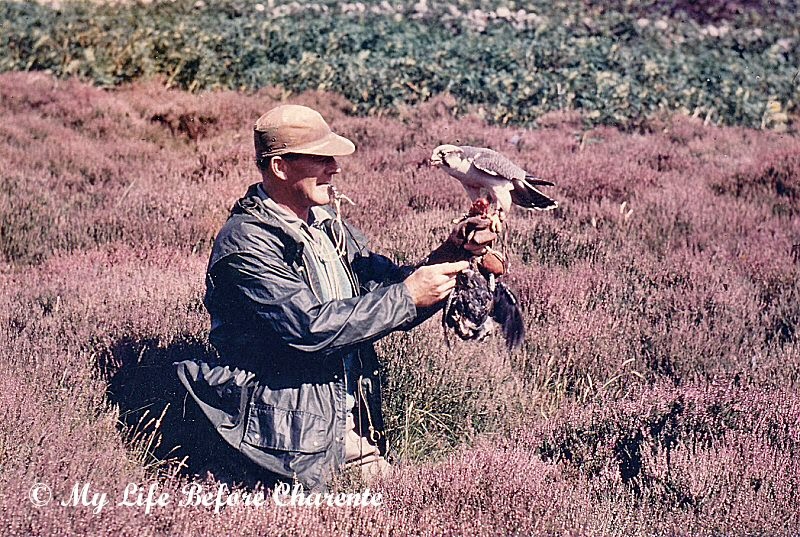
John Condy with Sasha, a peregrine falcon. She has just caught a grouse, which, as you can see, is bigger than herself!

Zita the goshawk.


My Life Before Charente to be continued :-) 


The section of my life story during our overland trip is published on Kindle if you should be interested:-
 THE GREAT 1953 TREK
See


Tuesday, 20 January 2015

The early sixties and nearly the end of my riding career.

During 1962, I had entered National Anthem in a few small shows, and although he seemed to enjoy his jumping, he really did not show very much potential! Nevertheless, he won a few showing classes, but as my interest was mainly in show jumping, I am afraid I did not have the patience or the time to spend hours schooling him at dressage and showing in general.   I did enjoy riding him though and Dad kept him fit and in basic training for me with the string of race horses he was training each day. 
National Anthem above and below.

In April 1963, my riding career almost came to an end; when riding a horse called Performance, trained by Jack Perry, in the Rhodesian Grand National, we hit the ground harder than planned at the very first fence! On the approach, we had a horse on either side of us; both of these horses jumped at an angle towards us, squeezing us out, right in front of the fence. We fell heavily and Performance sadly broke his back and was put out of his misery there and then on the race course. I was a little luckier, also with a broken back, but I woke up several days later in hospital in Salisbury. The break was high between the shoulder blades, and finally after a period I was back on my feet again, but with strict instructions that I was not to consider getting on a horse again for at least six months, and it would probably be closer to twelve months. Only after the six month check-up would I know if I could ride again!

To tell me that I cannot do something is like waving a red rag to a bull, and although I have to admit to some pain early on, I was back at work and riding within three months. At my six month check-up, the surgeon said he was pleasantly surprised at how well my back was doing and that the muscles were well built up and giving lots of support. If I liked, I could go out for the occasional quiet hack once more!! I never did admit to him that I had been riding for the past three months and not just hacking, but riding work and show jumping as well! I shudder now at the thought of what I did; if I had taken another tumble during the healing process I could well have spent the remainder of my days in a wheelchair.

Back at work; my boss Jack Perry, with All's Fair, a filly imported from the U.K. 

It was decided during 1963 that Jewel’s Reward would be better schooled and trained to see if he was any good for show jumping. The saying is ‘horses for courses’ and that was exactly what the story was so far as Jewel’s Reward was concerned. At Marandellas, he was a flying machine (see previous post), but at Borrowdale, Salisbury's main race course, he showed little interest at all. So far as I remember, he ran one second place at Borrowdale, in a  field of useless horses! He seemed to enjoy schooling, and I have to admit that I probably enjoyed working with him so far as dressage was concerned, more than any horse I had owned to that date. He was intelligent and although not very big, being about the same height as Hy-Li-Li, he was well muscled and showed great promise. In July 1963, he won Champion Hack, a local horse show event where quality and good manners of the horse are particularly important. He behaved like a perfect gentleman in the ring. Soon after, he  won his first show jumping event, which was a speed event that he flew around, being seconds faster than any other horse in his class! I knew that he was never going to be an outstanding show jumper, his small size being against him, but I could see lots of fun in the future especially where speed events were concerned!

Jewel's Reward with me in training,

During 1963, another horse took my eye, one which had been brought up from Johannesburg by one of the other trainers. His name was Kubla Khan, and he looked to me as if he would make the perfect show jumper, if he had the right temperament! He was beautifully bred, being by Abadan II out of Neural, which made him a half-brother to Migraine, the filly that won the famous Durban July race in the 1950's. I spoke to the trainer and owner, and they promised me if, and when, he came up for sale, I would get first option to buy him! This in fact happened the same year, as he was not showing any promise on the track. So Kubla Khan joined my string of horses right in the middle of the show jumping season! 
Kubla Khan.

It was decided that as he was racing fit and I had little time to school him, Dad would keep him in training temporarily, and if there were any races for which he looked suitable, Dad would give him a run. I think this was an unpopular decision with the previous owners, but, as no agreements not to race him had been made, there was little they could do. The decision, I suspect, was even more unpopular when Kubla Khan won a race just at the end of the show jumping season and I was ready to start schooling him! Again I think that my Dad’s training principle of treating each horse as a separate animal paid off, and Kubla Khan retired from racing on a winning streak!

Kubla Khan took to show jumping like a fish to water; he would tackle anything and was possibly turning out to be the best horse I had ever owned!


My Life Before Charente to be continued :-) 


The section of my life story during our overland trip is published on Kindle if you should be interested:-
 THE GREAT 1953 TREK
See


Sunday, 30 March 2014

Selling a couple of my horses and Dad takes out his licence as a racehorse trainer.

At the beginning of 1961, the Mozambique Army approached me with an offer to buy Kismet from me; we were not really getting on that well together and the offer was a good one, so I accepted it and thus the stable shrunk to three horses. 


Kismet on his way to a new country.
Only a few weeks later, our  stable number reverted to four horses, when my boss, Bill Wakefield, offered me his stallion National Anthem, who had unfortunately proved to be sterile. 
National Anthem
National Anthem had been imported from the United Kingdom to stand at Borrowdale Stud. He had been second in the Derby Trial Stakes in the UK and had an impressive blood line. With the Derby winner Straight Deal as his sire and his great grand sire being Gainsborough, he would have improved the Rhodesian blood line no end, but sadly this was not to be. He was a very grand looking dappled grey of 16.3 hands high, with an amazing temperament for a stallion. He had not been ridden for some years, so training meant starting again at square one and I spent many hours with him in basic dressage and over small fences. 

National Anthem and myself in mid air over a fence.
Rustler, meanwhile, was proving to be a real handful and although we had a few wins along the way, I was fairly certain that he was never going to become anything other than average, whilst also causing me some dramatic surprises!

We were entered in one cross country event, where having discussed the water jump into a dam with various riders, it was decided that the sensible thing to do was take the first fence very gently, then ride around the shallow edge of the dam to take the second fence, out of the dam on the other side. Rustler, unfortunately, had his own ideas and, with some enthusiastic fly jumping approached the first fence. While I was trying desperately to slow him down, he took off for the jump with a huge leap that carried us right into the middle of the dam at its deepest point!  He was unable to keep his footing with the speed we were travelling and the inevitable happened; we somersaulted in the water. I was unable to hold on to the reins, and when I surfaced, blowing out jets of water, I saw him back on dry land, in a flat gallop, disappearing into the distance!  Fortunately, neither of us suffered any serious damage, but it really was the beginning of the end!  

A few weeks later, we found a buyer who was convinced they could do better with Rustler than I could!  I don’t ever remember seeing Rustler in the show ring again from that day on!

By 1962, Dad’s interest in horse racing had developed to the extent that he was keen to take out a trainer’s licence and start training race horses himself. A property on the Dombashawa Road in Borrowdale (a suburb of Salisbury) was up for rent, and it had a training yard of twelve stables, a tack room and a feed room, plus plenty of accommodation for the stable hands. It also had a small but adequate size training track, so a deal was struck and we rented out our existing house on the Lomagundi Rd and made the move to Borrowdale. It certainly suited me much better, as my drive to work was cut by half the distance!

Hy-Li-Li and myself in a cross country event. This time we stayed together, not as I did with Rustler in my narrative above!

The first two horses to move into our new yard, besides Dusky, National Anthem and Hy-Li-Li were Lady Heath and Jewel’s Reward. Lady Heath was a seasoned hurdler and Jewel’s Reward was a two year old that had been home bred and was still owned by the breeder. 

In May that year, Lady Heath became my Dad’s first winner, when, with me riding, she won an amateur hurdle race at Marandellas, a small town not far away.   Dad then found owners who were prepared to give him a chance with their horses and so he filled the stables up with flat race horses; mainly ones, I might add, that had been rejected by other trainers as being unsuccessful!  Because he trained each horse as an individual and not using bulk training, he had a certain amount of unexpected success with these rejects.  Unexpected it was to other people, but not really to us, as my Dad was very committed to this new activity.  The stable expanded again and another 6 stables were built at the back,  soon to be filled with new prospects!


Myself leading Rear Guard into the winner's enclosure for my Dad (who is holding my handbag for me!).  The owner, Jack Quinton, was absent on that day, so the honour went to me!


My Life Before Charente to be continued :-) 

 
The section of my life story during our overland trip is published on Kindle if you should be interested:-
 THE GREAT 1953 TREK
See


Sunday, 9 March 2014

Another horse for show jumping and starting work at Borrowdale Stud.

In August 1959, I took Hy-Li-Li to her first amateur race meeting at Gatooma, where she won both the first sprint of the day over 4 furlongs and the final race of the day over 6 furlongs!
Diane at an amateur race meeting on Hy-Li-Li
All three of my horses were well and truly coming up to expectations and doing their best. It was not long after this, that I was out exercising Kismet and just on the last stretch home, we walked through a large puddle of water. I had forgotten Kismet’s love of water and he liked nothing better than to have the sprays watering his paddock, so he could just keep walking over the top of them. He also was the only horse I ever knew who, if he had a big enough trough to drink from, would put his head right in up to his eyes. I was digressing - the end result of the puddle incident was that he caught me completely unawares and dropped straight into it, to try and roll - rider, saddle and all! He came out of it with a slight scratch on his knee, but I ended up with a broken elbow!  This was a huge setback for me, as this time there was no plaster for support and I was in a sling for close on 6 weeks. I was told that there had to be movement and controlled exercise during the healing process, as it was thought it may set in a locked position otherwise.  I might add here that when I got home, my Mum was frantic about the scratch on Kismet's knee and cold compresses were applied to alleviate any swelling. It was only the next day that anyone believed that I had damaged my elbow and so was taken off for x-rays!!

While still in a sling and feeling sorry for myself, Dad asked me one day if I would like to help him collect some horses that had arrived at the railway station. There were seven race mares imported from the United Kingdom; initially they were all for racing and later they would be put to stud to bring in some new and excellent blood lines as part of the country's breeding programme. They were consigned to Borrowdale Stud (Borrowdale is a suburb of Salisbury), which comprised a large racing stable with stud attached. I naturally jumped at the idea and off we went to the station to collect them. It was here that I met Bill Wakefield, the owner of the stud, and his trainer Jack Perry. By the time we had settled the horses at the stud, it was arranged that I would start work there in the January of 1960. I finished school in December 1959 and so it was, with great excitement, that I went off to work in the New Year. 

Working in racing stables meant a very early wakeup call, being on the road by 04h30  and with the first string of racehorses we would be out of the yard by 05h30!  By then, my elbow had healed well and I would ride work with either one of the stable lads or with our regular Irish jockey Johnny Roe, who used to come out to the stud three times a week.  Johnny, on returning to his home in Ireland a few years later, became champion jockey there 9 times.
Johnny Roe on one of my all time favourite race horses 'Snack' at Borrowdale Stud.
Luckily for me, in Rhodesia I could take my car driving test at 16, so driving to work and back was not a problem. Dad bought me a very old long wheel base Lloyd (now a very rare make!) which served the purpose well. I have to admit, though, to having one serious mishap one morning on the way to work. The route at one point descended quite a steep hill and at the bottom of the hill the tarmac stopped and the road turned abruptly into a loose sandy surface. I was driving a bit too fast and on reaching the sand, I started to go into a slide; lack of experience caused me to put my foot on the brake which made the car do a complete roll-over and back onto its wheels again!  The vehicle looked a little the worse for wear(!) but was still running and I seemed to be intact, so I carried on to work. The reality of what I had done hit me when Jack Perry came running out and saw the car! He phoned my Dad and put me on a horse and sent me off to concentrate on other things. Mum and Dad came out to collect the car and took me home later in the morning. The whole episode did one good thing for me, though. It taught me never to hit the brake if your car is in a slide! In later years, I did training on a skid pan and learnt exactly how to handle that and other situations on slippery surfaces. Basically I was none the worse for the experience, just a whole lot wiser and Dad found another small car for me to use to go back and forth.

Early in 1960, Hy-Li-Li was really on form and won several point-to-points and a number of show jumping events. Dusky, meanwhile, was coping very well with the lower show jumping grades in the adult classes and Kismet was getting the odd place but was not showing any dramatic improvement. 
Myself and Rustler at Salisbury Show (now Harare). Salisbury show was a big event and riders from South Africa used to travel up to it.
Towards the end of 1960, Rustler joined the stable and we were then up to four horses. Rustler was a very flighty bay  about 16 hands high, with a nasty habit of ‘fly jumping’ when approaching a fence. This is similar to jumping imaginary jumps, usually when the rider least expects it! He generally succeeded in putting me in the position of being unable to correct his stride so he was in the right position for the fence we would be approaching. I spent many hours training over small fences to try and prevent his exuberance, but although he improved, we never did really get it right.
Myself and Rustler at Sinoia Show; the biggest event of the year, the Show Jumping Derby, was held here.
In September of 1960, we had the Horse of the Year Show at Chikarubi Farm, just on the outskirts of Salisbury. I took all four horses. Kismet and Rustler were a complete disaster, knocking fences over in all directions, Hy-Li-Li certainly did not let the side down, but in the main event for which we had to qualify, Dusky really came into his own!   It was a handicapped event, which is unusual in the show jumping world, and it involved C grade up to A grade horses.

Grading in Rhodesia was done, at that time, using points awarded for success in show jumping events, with A grade being for the most successful horses. D grade was for beginners, who hoped soon to move up the ladder!

By then, Dusky had been upgraded to C and was finding the fences just about at his limit. He managed a clear round first time on the course and then had to jump off against the clock. As there were both A grade and B grade horses in the jump off who were much larger than him, his chances were not very good as his stride was just not able to lengthen enough to cover the ground as fast as they could. What none of us had taken into consideration was that because of his small size, he was able to manoeuvre and turn far more easily, thus shortening the distance and time between fences.  I have never been so proud when the final results came through, to find that Dusky’s clear round was 0.5 of a second faster than anyone else!  There were huge celebrations with Dusky drinking beer (no champagne available) out of the Horse of the Year trophy. This was his final event in the show jumping arena, as I knew he was not capable, or large enough, of being upgraded any further, so he retired in the glory of being named Horse of the Year in 1960.  I was so proud of the little pony.
Myself with Kismet at the back and Dusky in the front.
I am finishing up this episode with a few newspaper cuttings from the local Salisbury paper, in case anyone should be interested! The photos aren't very flattering and you will note that there are several minor errors of fact, my Christian name being spelt with an 'a', for one.  Also errors with my height and age, which has an apology attached! Journalism and printing processes have come a long way in the last 50 years!

Being led into the winner's enclosure on 'Seaforth' by the owner, Mr Dalrymple

19 October 1961

My Life Before Charente to be continued :-) 

 
The section of my life story during our overland trip is published on Kindle if you should be interested:-
 THE GREAT 1953 TREK
See